

The Eight Most Effective Natural Ways to Keep Your Brain Sharp
Did you know that what you eat and how well you digest and absorb foods directly affects your brain function?

Exercising your mind by reading can certainly keep your brain sharp, but exercising your body and choosing the right foods can also help you preserve memory and your happy mood.
Your Liver and Your Brain
Your brain communicates with the rest of your body using neurons that “fire,” sending out impulses via ions and neurotransmitters that tell your body what to do, how to feel, and what to think.
Most neurotransmitters are made of non-essential amino acids manufactured by your liver. The neurotransmitter serotonin, however, is manufactured in your gut. Since you cannot get these amino acids directly from food intake, you need to ensure that your liver and your intestines are functioning optimally so that they make these vital amino acids.
If you have been following the Body Ecology system of health and healing you are now well aware that healthy food intake and proper digestion are key to liver and intestinal health. Your liver helps detoxify blood from your small intestine. When the intestines contain chemicals and toxins that are not purified by the beneficial microflora in your intestines the liver suffers greatly. Poorly digested foods ferment creating toxins, so it is critical that your foods digest completely.
This will ensure that your liver is protected from these poisons that cause it to become congested or have “stuck chi.” This will keep your liver healthy and able to make the amino acids you need for neurotransmitters.
Heart Health Improves Brain Health
Besides maintaining liver health, most neuroscientists agree with Maria Carillo, director of medical and scientific relations for the Alzheimer’s Association, that “what’s good for your heart is good for your brain.”
Making sure that you have a healthy cardiovascular system also prevents stroke, one of the leading causes of dementia in older people.
Exercise, keeping your arteries clear, and monitoring cholesterol all improve the functioning of your brain, which uses two thirds of your body’s blood supply! So get outside and take walks, and choose foods (like the ones we list below) to keep your heart and your brain healthy.
Fat for Your Head
Another essential component to brain function, and possibly the most important, is eating plenty of high-quality fats. Equally important is avoiding the partially hydrogenated fats found in margarines and fried foods. Of course, while eating these fats is a must digesting them is even more important.
Good fats that provide both saturated fats and omega-3 fatty acids (EFAs) are essential for a baby’s brain development in the womb and continues throughout the entire life. In fact, your brain is mostly made up of fat!
The right choice of fats can actually make you smarter and keep you happy; they have also been linked to less frequency of depression and higher IQ’s. For more information on choosing quality fats, read: A Key Health Secret That Everyone Should Know: Eat a Range of Good Oils.
How to Feed Your Body to Nourish Your Brain
Since diet plays such an essential role in keeping your brain happy and healthy, here are some easy ways to boost your brain power, naturally!
- Eat cruciferous vegetables like cabbages, broccoli, kale and collard greens. In one study, two or more servings of these vegetables daily was linked to improved mental functioning. These veggies can be easily fermented into cultured veggies to make them even more digestible and nutritious. Learn the best way to eat these vegetables and read Why You Need to Cook These Vegetables for Maximum Nutrition.
- Try Body Ecology grain-like seeds (buckwheat, quinoa, amaranth and millet). These high protein seeds have all the benefits of grains yet are gluten-free and very high in protein. They help your body make serotonin, the neurotransmitter that helps you feel happy. Serotonin converts to melatonin at night helping you have a better night’s sleep. This is one of the reasons we suggest you eat these grain-like seeds as part of your evening meal. You can get all of these grains conveniently online at the Gluten-Free Mall.
- Include organic, unrefined fats from fish, seeds and nuts. Wild Alaskan salmon & other healthy fish are top sources. Fish oil, cod liver oil and walnut oils are also good sources of omega- 3 fatty acids. Both raw and roasted pumpkin seed oil have zinc, vitamin E and niacin. These along with extra virgin olive oil, organic gluten-free extra virgin coconut oil, red palm oil, evening primrose, borage and flaxseed oil make up a wide variety of excellent oils that are a part of The Body Ecology System of Health and Healing.
- Saturated fats like raw butter and ghee are a must as well. Of all the fats, raw butter most closely duplicates the saturated fat found inbreast milk. Please remember that breast milk is rich in raw saturated fat because it is essential for the baby’s developing brain. Pregnant women should eat raw butter and ghee before and during their pregnancy to ensure that their baby’s brain is well developed before birth but also after birth as well. Woman who cannot nurse or who are concerned that their breast milk lacks adequate amounts of this vital fat should put tiny spoonfuls of raw butter and ghee into their baby’s mouth several times a day. This has been a common practice in India for thousands of years and babies love the taste. Be sure to read, Baby Formula: The Key Health Risks to Baby that Every Mother & Someday-Mother-to-Be Needs to Know.
Sadly, when America turned to margarine and processed fats and started to believe that butter was bad for us, we stopped feeding our brains the saturated fat it needs to help prevent Alzheimer’s, ADD and even autism. Many of us will remember the margarine commercial on television where a woman dressed as an angry Mother Nature warned us: “It’s not nice to fool Mother Nature.” Decades later we can see that she was right. Today, we are paying a heavy penalty for trying to do so.
If a goal in your life is to become healthy and happy, now more than ever it is essential to avoid processed fats like canola oil and vegetable oil. They have been bleached, deodorized and refined. Basically they are a poison and are especially damaging for your liver. For more information,read Why The Processing of Consumable Oils Has Devastated America’s Health.
- Eat lightly cooked egg yolks. Egg yolks contain choline, a member of the vitamin B family that can “supercharge” brain cells in developing babies, and is part of a key memory neurotransmitter.
- Add ocean vegetables to your diet. Sea vegetables not only have omega-3 fatty acids but also contain all 52 minerals your body needs to function. Even better, they have a higher concentration of vitamins than any other food! Experiment with adding ocean vegetables like nori, kelp, hijiki and wakame to your diet or try Body Ecology’s own Ocean Plant Extract. Be sure to check out the recent article,Russia’s “Miracle” Heavy Metal Cleansing Sea Vegetable.
- Cleanse your liver. Your liver makes the amino acids necessary for your brain to function. Nourish your liver with foods and supplements that support its function. The liver likes green foods like our Vitality Super Green with chlorophyll and fermented algae.
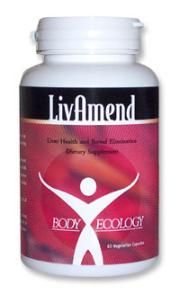
LivAmend is a specially formulated supplement that supports liver function, increases bile flow and improves bowel elimination – which is all essential for physical AND mental health. It has also helped many people with constipation problems.
Body Ecology’s LivAmend was developed to increase bile flow so that toxins could smoothly leave the liver. When you increase the flow of bile peristaltic movement in the intestines also increases so that you can eliminate those toxins in your stool each day. LivAmend has helped many people with constipation problems.
- Improve your digestion with fermented foods and drinks. Fermented foods, beverages and probiotic liquids are rich in beneficial microflora that help you digest food and absorb more nutrients to feed your body and your brain. They also help stimulate your liver’s ability to cleanse and function optimally. Learn how to make your own cultured vegetables and Young Coconut Kefir at home, and be sure to learn more about Coco-Biotic and Dong Quai. These liquid probiotics are from a food source and are the most potent and effective way to add friendly microflora to your digestive tract. They are convenient, economical and delicious!
Don’t let forgetfulness or a complete loss of memory stop you from enjoying a long, healthy life surrounded by those you love. Keep yourself healthy and smart by feeding your brain AND your body at the same time with memory enhancing foods. You’ll feel great physically and mentally!
Sources:
- Bhattacharya, Shaoni, “Nutrient During Pregnancy ‘Super-Charges’ Brain,” NewScientist.com, 12 Mar 2004. http://www.newscientist.com/article.ns?id=dn4771
- Brain Chemistry: Reason We Feel Like We Do, IcakUSA.com. http://www.icakusa.com/healthcaps/nutrition/index.html
- Brain Nutrition, The Brain Center, NutraMed.com. http://www.nutramed.com/brain/brain_nutrition.htm
- Brain Power Nutrient Guide, PsychologyToday.com. http://psychologytoday.com/articles/pto-19960501-000039.html
- Feske, Steven K., “Avoiding Dementia: Fitness and Your Brain,” Newsweek.com. http://www.msnbc.msn.com/id/9467736/site/newsweek/
- Health Benefits of Seaweed, LoveSeaweed.com. http://www.loveseaweed.com/health.html
- The Human Brain, FI.edu. http://www.fi.edu/brain/fats.htm
- McKeith, Gillian, “Living Food For Health,” Piatkus Books, 2000. http://www.positivehealth.com/Reviews/books/mckith53.htm
- Tropical Plant Database, Rain-Tree.com. http://www.rain-tree.com/artichoke.htm
- Vegetables May Keep Brains Young, Associated Press, FoxNews.com, 24 Oct 2006. http://www.foxnews.com/story/0,2933,224317,00.html
- Vitamins and Health Supplements, Vitamins-Supplements.org. http://www.vitamins-supplements.org/amino-acids/
LATEST ARTICLES

POPULAR ARTICLES



Customer Reviews

Really settles my stomach. Love it!
This is an excellent probiotic, I drink it daily.


